Library Preparation
Highly Sensitive Protein Analysis with Nanogram Inputs
Unlock biological samples with Library Prep Kit V3 for robust library construction from 200 ng protein.

Library Preparation Kits
High-confidence protein sequencing from nanogram inputs with Library Preparation Kit V3.
Protein Sequencing Kits
Achieve deeper protein insights with ready-to-sequence chips, recognizers, and aminopeptidases.
Assess scarce samples with Library Prep Kit V3

Nanogram input
Construct NGPS libraries with 200 ng total protein, delivering high-confidence sequencing from limited protein sources

Low-abundance detection
Reliably detect low-abundance proteins with high coverage down to 1 ng or 0.5% in a mixture

Resolve immunoprecipitates
Enhanced bioinformatics assess proteins immunoprecipitated from biological samples, like cell lysates, uniquely differentiating proteins in a mixture with precision

Fast and familiar workflow
Updated protocol yields sequenceable libraries within 48 hours, with less than two hours of hands-on time
Reduced Input for Targeted Proteomics
- Library Preparation Kit V3 was designed to significantly reduce the input needed to produce high-quality NGPS libraries.
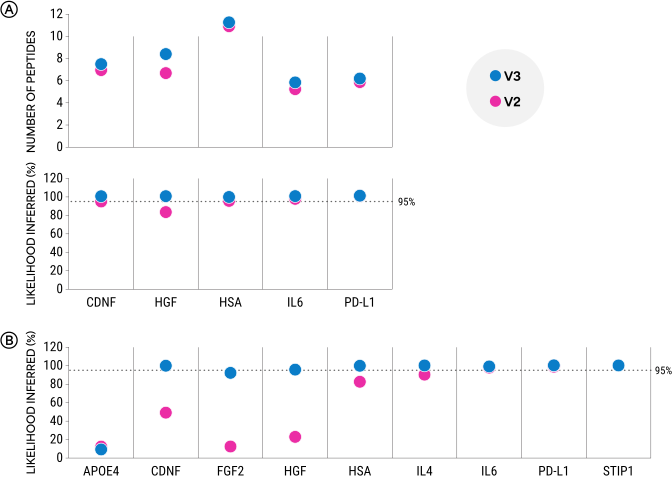
- More data from less protein: 5-protein mix libraries were produced from 200 ng compared to 8-40 μg with the V2 kit, delivering elevated peptide coverage with over 95% confidence.
- Resolve protein mixtures with confidence: 10-protein mixture sequenced at 200 ng (~20 ng per protein) with the V3 kit compared to 7.6–33 μg (0.76–3.3 μg per protein) from the V2 kit showed improved precision.
Resolve Immunoprecipitated Protein Mixtures
- Upgrades to the inference software enhance confidence in identifying proteins in complex mixtures, with only nanogram amounts of input protein.
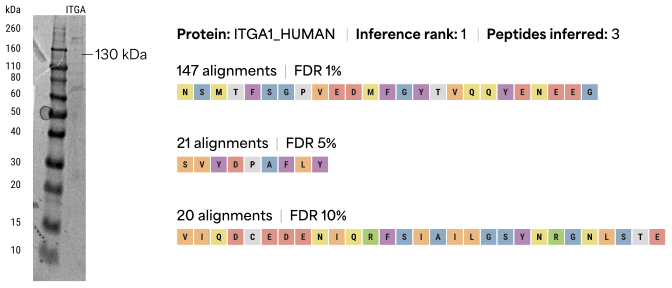
- Libraries were generated using the V3 kit from HEK293 cell extracts derived from 106 cells expressing FLAG-tagged integrin alpha-1 (ITGA1) following immunoprecipitation.
- NGPS accurately identified the ITGA1 protein with top-ranked inference using Sequencing Kit V4 on the Platinum Pro platform.
Sensitive Identification of Protein Mixtures
Proteins have diverse intrinsic properties that impact their performance across proteomics assays. To characterize the limit of detection of low-abundance proteins in a mixture, a panel of five proteins was titrated in mixtures with a constant total protein of 200 ng per library. Here, ADML was maintained at high abundance (40–196 ng), while four others (LMNB1, PD-l1, HSA, and ILI8R) stepped down from 0.5–40% (1–40 ng) per protein to model performance at low abundance.
Libraries were prepared with Library Preparation Kit V3, sequenced on a full chip using Sequencing Kit V4 on Platinum Pro.
Highest-coverage proteins (LMNB1, PD-L1, HSA):
- Accurately detected with ≥95% confidence
- LMNB1: reliably inferred at 1 ng in the mixture (0.5% abundance)
- PD-L1 and HSA: reliably inferred at 2 ng (1% abundance)
Lower-coverage proteins (IL18R, ADML):
- Required higher mass for high-confidence detection
- IL18R: required 80 ng (40% abundance) to reach high-confidence inference
- ADML: required 160 ng (80% abundance)

Explore our resources to discover how Next-Gen Protein Sequencing with Platinum Pro can enhance your protein research
The Platinum instrument, kits, and software contain everything you need to prepare, sequence, and analyze proteins. Library preparation is the initial step in Quantum-Si’s Next-Generation Protein Sequencing workflow.
The Platinum instrument, kits, and software contain everything you need to prepare, sequence, and analyze proteins. Sequencing Kit is the second step in Quantum-Si’s Next-Generation Protein Sequencing workflow.
In this study, published in the Journal of Proteome Research, Gloria Sheynkman and her team evaluated the ability of the recently released Platinum single-molecule protein sequencer to detect proteoform-informative peptides. Platinum employs fluorophore-labeled recognizers that reversibly bind to cognate N-terminal amino acids (NAAs), enabling polypeptide sequencing within nanoscale apertures of a semiconductor chip that can accommodate single peptide molecules.
This article, published in Science, illustrates how the study of the proteome would benefit greatly from methods to directly sequence and digitally quantify proteins and detect posttranslational modifications with single-molecule sensitivity.
Since our groundbreaking debut in Science in 2022, Quantum-Si has been at the forefront of protein sequencing innovation. Our commitment to progressive innovation has led to significant advancements in our next-gen protein sequencing technology.